
Overview of the project
BUSTIC EDU is an international project involving five countries and seven partner organisations, aimed at fostering a nature-positive relationship for learners and teachers through an integrated approach to teaching and learning.
The project seeks to raise awareness of the impact that sustainability education can have when delivered through an integrated and competence-based approach by incorporating the GreenComp Framework, the Eight European key competences, the Digital Comp 2.2, now 3.0, and the STEM competences amongst others. It does provide a holistic approach to sustainability which builds connections amongst the different areas.
What is the project about?
The Sustainability Education Programme, developed within the BUSTIC EDU project, offers a comprehensive framework for integrating sustainability into early childhood, primary, and secondary education. In response to European and global policy priorities, the Programme positions sustainability competences as essential components of 21st century learning, alongside STEM, digital literacy, and interpersonal skills.
Grounded in the GreenComp Framework and informed by research on gaps and needs in sustainability education, the Programme translates sustainability principles into practical pedagogical guidance. It is organized into thematic modules tailored to different educational stages and complemented by methodological guidelines for implementation. To support educators, it provides ready-to-use teaching and learning materials that can be adapted to diverse national contexts and varying levels of teacher expertise, enabling both cross-curricular and subject-specific approaches.
At its core, the Programme builds on five key pedagogical approaches: integrated teaching and learning, which promotes multidisciplinary perspectives; competency-based education, which emphasizes outcomes and learner accountability; the whole-school approach, which embeds sustainability into school culture; reconcilism, which fosters the human–nature (re)connection; and capacity building, which empowers educators and institutions.
Designed for three distinct educational levels, the Programme addresses the unique developmental needs of learners.
Early childhood education focuses on well-being, identity, belonging, communication, and exploration through play and inquiry.
Primary education emphasizes literacy and conceptual understanding through concrete examples and relatable problems.
Secondary education supports abstract and hypothetical thinking, deepens subject knowledge, and cultivates functional competences for active citizenship and sustainability. Across all levels, activities prioritize experiential, project-based, and collaborative learning, nurturing critical thinking, systems thinking, and active citizenship.
Source: Šimšić Vulić, I., Pupavac, M., Rajić, D., & Topalović, S. (2025). Sustainability Education Programme for General School Education – December 2025. Foundation Tempus, Belgrade.
What is the GreenComp Framework?
GreenComp comprises four interrelated competence areas: ‘embodying sustainability values’, ‘embracing complexity in sustainability’, ‘envisioning sustainable futures’ and ‘acting for sustainability’. Each area comprises three competences that are interlinked and equally important. GreenComp is designed to be a non-prescriptive reference for learning schemes fostering sustainability as a competence.
Source: Bianchi, G., Pisiotis, U. and Cabrera Giraldez, M., GreenComp The European sustainability competence framework, Punie, Y. and Bacigalupo, M. editor(s), EUR 30955 EN, Publications Office of the European Union, Luxembourg, 2022, ISBN 978-92-76-46485-3, doi:10.2760/13286, JRC128040.

Figure 1: The Visual of the GreenComp Framework, reproduced from Bianchi et al. (2022)
Further information can be found by accessing any of these links:
Greencomp in a nutshell – https://www.youtube.com/watch?v=fMGc0Zqbd_U&t=61s
GreenComp-
- Future Literacy: https://www.youtube.com/watch?v=3s_pCpvHGac
- Adaptability: https://www.youtube.com/watch?v=w1J8BMSjH-w&t=8s
- Exploratory thinking: https://www.youtube.com/watch?v=Z_qlJRZozXw
- Individual initiative: https://www.youtube.com/watch?v=Z_qlJRZozXw
- Collective action: https://www.youtube.com/watch?v=Xc_D3ktoFG0
- Political agency: https://www.youtube.com/watch?v=Xc_D3ktoFG0
Malta’s role
Malta, through the Directorate for STEM & VET Curriculum Hub (DSVP), is an active partner responsible for work package 5 (WP5) involving the implementation of the piloting phase. Its contribution consisted of the writing of the policy experimentation protocol and the guidelines for the Heads of School alongside its active participation in the meetings and continuous communication between all the partners.
Teacher training programme (TTP)
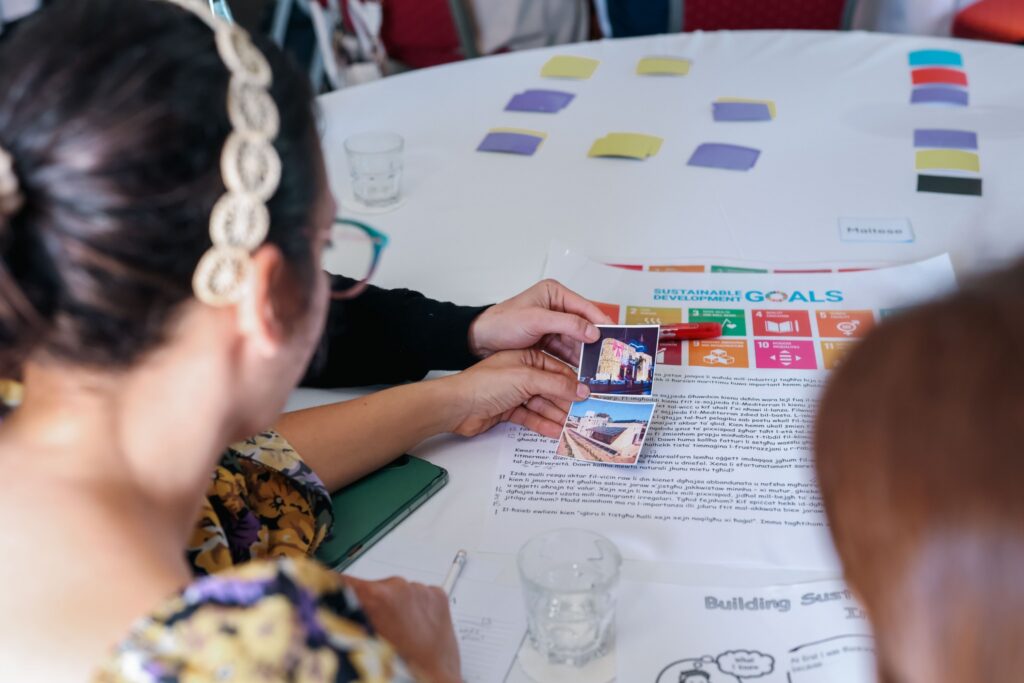
In parallel to the implementation phase of the other countries, Malta prepared for the training of the educators involved in the piloting and a full-day workshop was held on the 17th April 2026. Educators from the state and independent sectors were amongst the participants.




Objectives
The overarching objectives of the Teacher Training Programme (TTP) is to:
- strengthen teachers’ professional capacity to foster sustainability competences among learners;
- to foster sustainability competences among learners through the effective implementation of the BUSTIC EDU Sustainability Education Programme.
Aims
The TTP aims to:
- support teachers in understanding the GreenComp sustainability competence framework and its relevance for different educational levels;
- enable teachers to analyse and apply the thematic modules and learning scenarios of the BUSTIC EDU Sustainability Education Programme;
- prepare teachers for piloting sustainability learning activities in their own classrooms;
- promote reflective practice and peer learning through collaborative design and feedback;
Purpose
The TTP seeks to establish a shared conceptual understanding of sustainability competences and prepare teachers for pilot implementation of the Sustainability Education Programme.
Expected outcomes
The Teacher Training Programme is designed to:
- equip teachers with the knowledge, skills and professional attitudes required to effectively implement the BUSTIC EDU Sustainability Education Programme across different educational levels.
- place strong emphasis on enabling teachers to understand, interpret and apply the European Sustainability Competence Framework (GreenComp) in pedagogically meaningful ways.
- assist teachers in recognising sustainability as a complex and transversal competence.
Data Collection
To foster professional growth, data is gathered from students, educators, and school leaders regarding their relationship with sustainability. This process encourages a deep dive into how individual beliefs impact teaching and learning. With this baseline established, stakeholders can then create tailored action plans that turn reflection into tangible progress.
The Whole School Approach (WSA)
The Whole School Approach (WSA) to sustainable development is a framework that encourages schools to integrate sustainability across all areas that influence learning.
The metaphor is that of a flower: the heart represents the shared vision of the school, while the petals correspond to the different domains in which sustainability takes shape.


Teachers – self-assessment through the GreenMindframes Rubric
The GreenMindframes Rubric is a reflective self-assessment tool designed to help teachers explore how they integrate sustainability competences (from GreenComp) with professional mindsets (Hattie’s Mindframes) in their teaching practice.

Students
Student feedback is collected using a hybrid of paper-based and digital assessments. For early years learners (up to age five), the evaluation utilizes a visual-based format where students select images that correspond to their sustainability habits. This assessment tool is available at the following link: Early Years assessment up to five.
Primary and Secondary Students
Older primary (ages 8–11) and secondary (12+) students will participate in a pre- and post-pilot evaluation using multiple-choice questions. These assessments present scenarios based on real-life or hypothetical experiences, prompting students to reflect on their current habits or anticipated reactions. By comparing initial and final results, the data will be analysed to measure the programme’s overall impact on student perspectives.


Further details can be accessed through these links:
https://www.scientix.eu/community/partner-projects/bustic-edu
http://www.eun.org/projects/detail?articleId=13960045
https://publications.jrc.ec.europa.eu/repository/handle/JRC128040
Lesson activities can be accessed through Core and enrichment activities.